
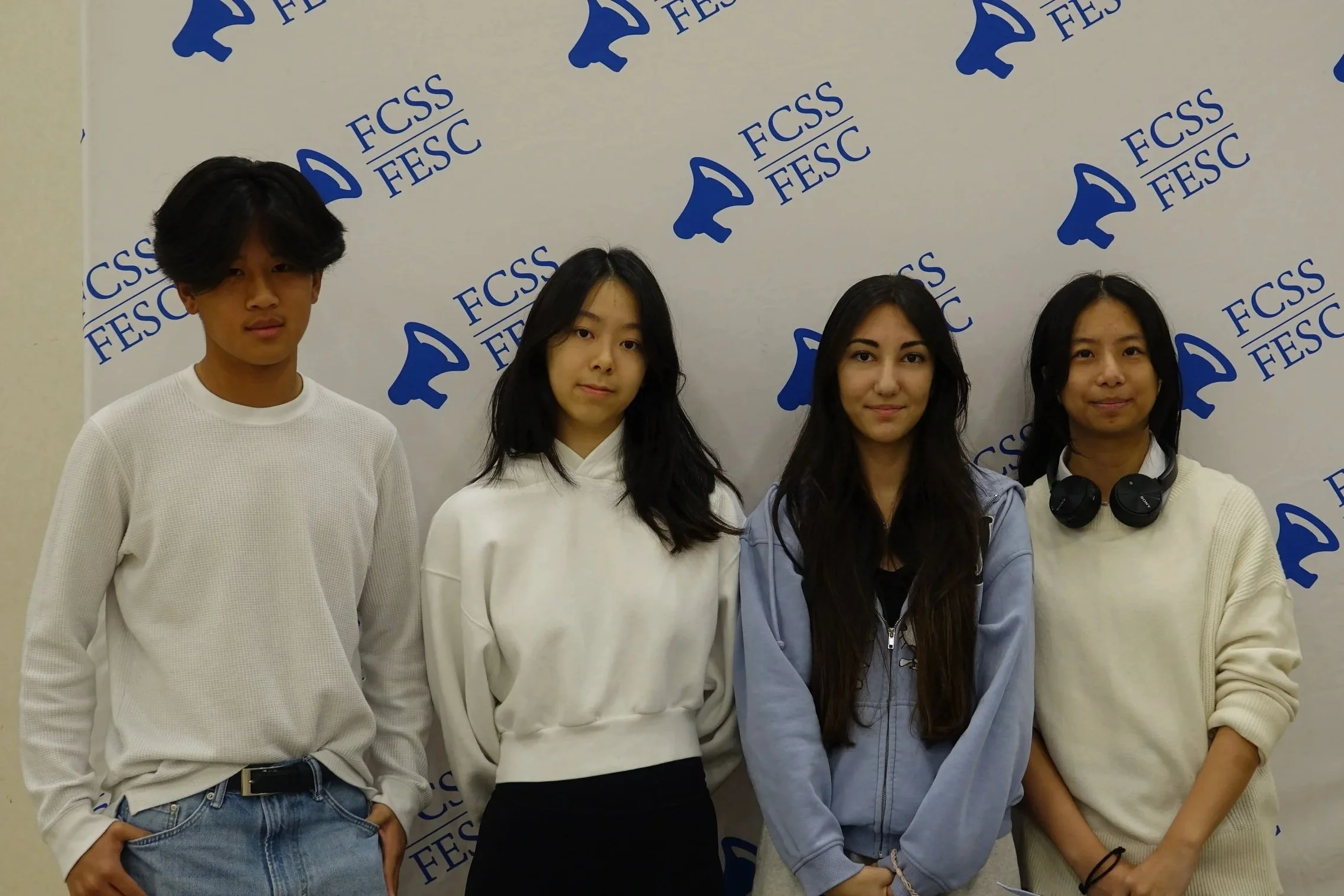
The Government Relations department is FCSS-FESC’s liaison to voice secondary student needs directly to government officials.
Government Relations

This department aims to publish regular policy briefs that identify pressing educational issues for youth, explaining how they occur and why they matter. Often, this includes research on pieces of legislation and their impacts on student wellbeing. Each brief ends with a list of recommendations that FCSS-FESC seeks to implement in partnership with government branches or other political organizations for a more accessible and engaging learning environment.
With these findings, the Government Relations team then engages in outreach to various offices and ministries to request their input and collaboration. By bringing youth voices to the table, FCSS-FESC hopes to introduce and contribute to policies that fulfill the changing realities of an excellent secondary education.
Policy Briefs
The policy brief, “An Epidemic of Cuts: The TDSB’s Shortfalls,” covers the increasing disparity between actual funding in the Toronto District School Board (TDSB) and that needed for student wellbeing in providing specialized programs. This is a case of chronic underfunding found in boards across Ontario. For Special Education Needs (SEN) students, there are insufficient educational assistants that the ratio of secondary pupils to teachers is 85:1, and fewer Identification Placement and Review Committee meetings are being carried out. Reports have demonstrated lower graduation levels, post-secondary offers, and employment amongst SEN youth. In the realm of mental health, there is a similar $10 million CAD deficit in supporting rising rates of psychological distress among teenagers and staff. Such emergency room visits have spiked 30% in Toronto, with further risks for low-income students. FCSS-FESC thus urgently presses for recommendations to be implemented, including targeted budgets for each institution, annual reports on failing sectors, and mandatory minimums for school social workers and counsellors, ensuring an equitable and inclusive learning experience for all.